Introduction
Engineers, product designers, and manufacturers face a critical decision when specifying materials for precision-machined components: hard-anodized aluminum and stainless steel appear frequently on the same spec sheets, yet perform in very different ways depending on the application.
Choosing the wrong material can compromise part longevity, corrosion resistance, dimensional tolerances, and total production cost — especially where tight specs and demanding environments are the norm.
This decision reaches well beyond cookware. It affects medical device housings, hydraulic systems, semiconductor equipment, and structural assemblies across multiple industries. According to industry data on material substitution patterns, manufacturers are actively switching from stainless steel to Type III anodized aluminum in applications from injection molds to fluid handling systems — driven by weight reduction targets, faster machining cycles, and comparable surface hardness. A misstep can mean field failures, costly redesigns, or regulatory non-compliance.
This guide breaks down the engineering realities of hard-anodized aluminum versus stainless steel across the dimensions that matter most—hardness, corrosion resistance, weight, machinability, thermal properties, and total lifecycle cost—so you can make the right choice for your specific application.
Key Takeaways
- Hard-anodized aluminum grows an Al₂O₃ surface layer reaching 60–70 on the Rockwell hardness scale — lightweight, thermally conductive, and electrically insulating
- Stainless steel (minimum 10.5% chromium) delivers self-healing corrosion resistance and superior structural strength without surface coatings
- Pick hard-anodized aluminum for weight-sensitive, thermally demanding, or cost-driven designs
- Pick stainless steel when maximum strength, chemical resistance, or regulatory compliance is non-negotiable
- Aluminum machines 2–4× faster with 3–5× longer tool life, which partially offsets the added cost of anodizing
Hard-Anodized vs. Stainless Steel: Quick Comparison
| Property | Hard-Anodized 6061-T6 Al | 304 Stainless Steel | 316 Stainless Steel | 17-4 PH Stainless |
|---|---|---|---|---|
| Material/Composition | Aluminum base + electrochemically grown Al₂O₃ surface (25-75 µm typical) | Iron-based alloy with 18% Cr, 8% Ni | 304 composition + 2.5% Mo for chloride resistance | Precipitation-hardened Fe-Cr-Ni with 3-5% Cu |
| Surface Hardness | HRC 60-70 (HV 350-450, alloy-dependent)* | HRB 70 / Brinell 123 | HRB 80 / Brinell 149 | HRC 36 / Brinell 352 (Condition A) |
| Density | 2.70 g/cm³ | 8.00 g/cm³ | 8.00 g/cm³ | 7.75 g/cm³ |
| Corrosion Resistance | Excellent in neutral/mildly acidic; >336 hrs ASTM B117 salt spray | Good general-purpose; vulnerable to chlorides | Superior in marine/chemical environments (Mo addition) | Good to excellent depending on heat treatment |
| Weight | Baseline (1×) | ~3× heavier than aluminum | ~3× heavier than aluminum | ~2.9× heavier than aluminum |
| Thermal Conductivity | 167 W/m-K (substrate); ~6 W/m-K (oxide layer) | 16.2 W/m-K | 16.3 W/m-K | Lower than austenitic grades |
| Machining Speed | 200-500 m/min milling | 50-120 m/min milling | 50-120 m/min milling | Slower than 304/316 |
| Relative Cost | Moderate (lower material + machining cost, plus anodizing) | High (material + tooling wear) | Higher (premium material + tooling wear) | Highest (specialty alloy + difficult machining) |
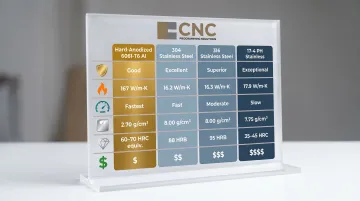
Hardness note: The HRC 60-70 range for Type III hard anodizing is widely cited by anodizing service providers and confirmed by Fictiv's technical guide. However, Products Finishing magazine expert Larry Chesterfield documents significant alloy dependence — 7075-T6 substrates yield approximately HV 350-360 (~HRC 37), while optimized alloy-process combinations can reach HV 520-700 (~HRC 50-60).
Always specify the substrate alloy when quoting hardness values in engineering documentation.
What is Hard-Anodized?
Hard anodizing is an electrochemical process where aluminum is submerged in an acid electrolyte bath and subjected to electrical current, converting the surface layer into dense aluminum oxide (Al₂O₃). Unlike plating or painting, this oxide layer is integral to the metal itself—it's not a coating applied on top. Semano Inc explains the layer penetrates approximately 50% into the substrate while building 50% outward, meaning it cannot peel or delaminate under normal service conditions.
Core Properties That Matter in Manufacturing
Hard-anodized aluminum delivers several properties critical to precision components:
- Reaches HRC 60-70 equivalent hardness (alloy-dependent), delivering strong wear resistance
- The Al₂O₃ oxide layer shields the reactive aluminum core from corrosion
- Electrically insulating at ~1 × 10¹⁴ ohm-cm resistivity—useful in electronics and semiconductor applications
- Conducts heat at 167 W/m-K through the aluminum substrate, roughly 10× better than stainless steel
- Holds tight dimensional tolerances post-machining, typically ±0.001" to ±0.005"
Type II vs. Type III Anodizing
The governing standard is MIL-A-8625, which defines six types and two classes of anodic coatings. For industrial applications, the distinction that matters most is Type II versus Type III:
| Characteristic | Type II (Conventional) | Type III (Hard Coat) |
|---|---|---|
| Oxide thickness | 2.5-12.7 µm (0.0001-0.0005") | 25-150 µm (0.001-0.006") |
| Process temperature | ~70°F | Lower than Type II |
| Primary use | Decorative finishes, mild corrosion protection | Functional wear resistance, demanding environments |
| Typical applications | Consumer products, architectural trim | Aerospace components, hydraulic systems, medical devices |
Type III hard coat delivers the thickness and hardness required for engineering applications where the part will experience mechanical wear, corrosive exposure, or both. These properties translate directly into the industries where hard-anodized aluminum has replaced heavier or less versatile materials.
Use Cases of Hard-Anodized Aluminum
Hard-anodized aluminum fits best where multiple requirements intersect:
Aerospace structural components: Landing gear, hydraulic systems, brackets, and housings benefit from the weight savings and surface durability. PFI Inc. notes Type III anodized aluminum serves as a stainless steel substitute in aerospace structural parts, driven by a 3× weight reduction and up to 2× faster machining.
Semiconductor manufacturing equipment: Etching process chambers use hard-anodized aluminum for chemical resistance to process gases combined with electrical insulation properties.
Military and defense systems: Small arms, weapon components, and equipment deployed in marine environments rely on Type III coatings for corrosion and wear resistance.
Medical devices: Surgical instruments and devices requiring repeated sterilization use hard-anodized surfaces for durability and biocompatibility.
Performance data: Semano Inc reports Type III surfaces demonstrate wear resistance up to 100× better than untreated aluminum. Under Taber Abrasion Testing, hard-anodized surfaces lose less than 5 mg compared to untreated aluminum at up to 500 mg under similar conditions.
What is Stainless Steel?
Stainless steel is an iron-chromium alloy containing a minimum of approximately 10.5% chromium by weight, often with nickel and other elements. The chromium forms a passive oxide layer that spontaneously reforms when exposed to oxygen—delivering inherent corrosion resistance without any additional surface treatment.
This self-healing behavior sets stainless steel apart from hard-anodized aluminum, where the protective layer is finite and cannot regenerate once breached.
Core Properties Relevant to Manufacturing
- High tensile strength: Superior to aluminum alloys across all grades
- Temperature resistance: Performs in both cryogenic and high-temperature environments
- Chemical resistance: Non-reactive with most acids, bases, and solvents (grade-dependent)
- Weldability: Can be joined without compromising corrosion resistance
- Long-term integrity: No surface degradation or maintenance requirements
Common Grades for CNC Machining
| Grade | Type | Key Applications | Distinguishing Property |
|---|---|---|---|
| 304 | Austenitic | Food/pharma equipment, brewery/dairy, springs, fasteners | Most versatile, cost-effective stainless steel |
| 316 | Austenitic | Marine hardware, surgical implants, chemical processing | 2.5% Mo addition for chloride resistance |
| 17-4 PH | Precipitation-hardened | Nuclear reactors, aircraft turbines, oil field equipment | Highest strength (HRC 36 in Condition A) |
The machining trade-off: Stainless steel is significantly harder to machine than aluminum. DWJ documents aluminum mills at 200-500 m/min versus stainless steel at 50-120 m/min—a 3-4× speed advantage for aluminum. Tool life in aluminum is 3-5× longer. A pocket milling operation taking 30 minutes in aluminum would require 1.5-2 hours in stainless steel for similar geometry. This directly impacts per-unit production costs and delivery schedules.
Use Cases of Stainless Steel
Food and pharmaceutical processing falls under the 3-A Sanitary Standards, which mandate that food product contact surfaces be stainless steel conforming to ASTM A 959 composition ranges for 304/304L and 316/316L, with surface roughness Ra <0.8 microns. Hard-anodized aluminum cannot substitute in these regulated applications.
Marine and offshore equipment relies on 316 stainless steel specifically because of its molybdenum content. The Pitting Resistance Equivalent (PRE) formula quantifies this advantage: PRE = %Cr + 3.3 × %Mo + 16 × %N. ASM materials data confirms 316 resists sodium and calcium brines, hypochlorite solutions, and phosphoric acid—environments that would compromise 304.
Medical implants and surgical tools depend on 316L stainless steel for its biocompatibility and chemical inertness, which allow it to maintain dimensional and surface integrity through thousands of sterilization cycles.
Head-to-Head: Key Differences That Matter
Hardness and Wear Resistance
While hard-anodized surfaces reach hardness levels of (HRC 60-70), the oxide layer is thin—typically 25-75 microns for Type III. If the layer is breached through mechanical damage or abrasive wear, the soft aluminum core (approximately HRB 25-30 for 6061-T6) is exposed. Stainless steel is uniformly hard throughout: 304 at HRB 70, 316 at HRB 80, and 17-4 PH at HRC 36 after heat treatment. This makes stainless steel more reliable for applications with sustained mechanical impact or abrasive contact.
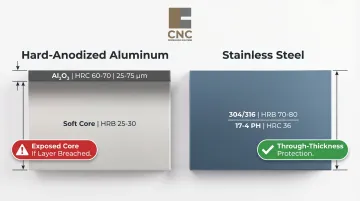
Hard-anodized parts require care to avoid gouging, cutting, or grinding through the protective layer. Stainless steel, by contrast, provides through-thickness protection with no surface layer to compromise.
Corrosion and Chemical Resistance
Where hardness determines mechanical durability, environment chemistry determines corrosion behavior — and the two materials respond very differently to specific conditions.
Hard-anodized aluminum exceeds 336 hours in ASTM B117 salt spray testing (5% NaCl fog at 35°C), demonstrating competitive corrosion resistance in many industrial environments. However, performance varies by environment chemistry:
- Neutral to mildly acidic: Hard-anodized aluminum performs well
- High-pH (alkaline) or concentrated salt-spray: The Al₂O₃ layer can degrade; 316 stainless steel maintains integrity
- Chloride-rich environments: 316 stainless steel's molybdenum content provides superior resistance; hard-anodized aluminum is vulnerable if the oxide layer is breached
ASTM B117 standard practice provides the test protocol widely used to evaluate relative corrosion resistance, though it does not perfectly replicate all real-world exposure conditions.
Weight and Machinability
The density differential is substantial:
- 6061-T6 aluminum: 2.70 g/cm³
- 304/316 stainless steel: 8.00 g/cm³
- Weight ratio: Stainless steel parts weigh approximately 3× more than equivalent aluminum parts
This affects handling costs, shipping expenses, and assembly ergonomics. In aerospace and robotics applications where every gram counts, the weight penalty of stainless steel is often prohibitive.
Machinability directly impacts cost: Industry data shows aluminum machines 2-4× faster with tool life 3-5× longer. While hard-anodized aluminum adds a post-machining finishing step, the total manufacturing cost often remains lower than stainless steel due to dramatic reductions in cycle time and tooling wear.
Thermal and Electrical Properties
Weight savings favor aluminum, and so does thermal performance — though the anodized layer introduces a nuance worth understanding before specifying it for heat management.
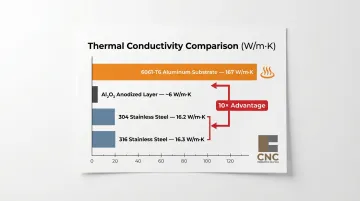
| Material | Thermal Conductivity (W/m-K) | Electrical Properties |
|---|---|---|
| 6061-T6 aluminum (substrate) | 167 | Good conductor |
| Al₂O₃ anodized layer | ~6 | Insulator (~10¹⁴ ohm-cm resistivity) |
| 304 stainless steel | 16.2 | Moderate conductor |
| 316 stainless steel | 16.3 | Moderate conductor |
The 10× thermal conductivity advantage makes aluminum the clear choice for heatsinks, thermal management enclosures, and applications requiring rapid heat dissipation. The thin anodized layer itself has lower conductivity (~6 W/m-K) than the substrate—but at typical thicknesses (25-75 microns), overall part performance remains far superior to stainless steel.
On the electrical side, the extreme resistivity of Al₂O₃ creates a built-in dielectric barrier, useful in electronics housings and semiconductor equipment where electrical isolation is required. Portions of hard-anodized parts can be masked during processing to retain bare aluminum where conductivity is needed.
Longevity and Maintenance
Stainless steel requires virtually no maintenance and has no surface layer that can wear through. The passive chromium oxide layer self-heals when damaged. Hard-anodized parts require more care — scratches, gouges, or abrasive wear that penetrates the Al₂O₃ expose the reactive aluminum core beneath.
PFI Inc finds that lifecycle costs are typically lower for Type III anodized aluminum, driven by lower initial manufacturing cost, reduced shipping weight, and superior thermal properties in applications like injection molds where energy consumption matters.
That calculus shifts in harsh environments. Where mechanical abrasion combines with chemical attack, stainless steel's self-healing passivation and through-thickness protection often deliver better long-term reliability — even at higher upfront cost.
Which Should You Choose?
The right material depends on your load requirements, operating environment, regulatory constraints, and production economics. Use these criteria as a direct decision filter.
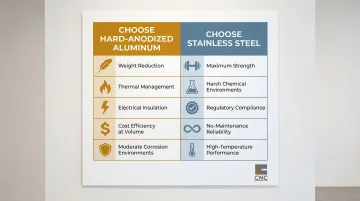
Choose Hard-Anodized Aluminum When:
- Weight reduction is critical: Aerospace components, robotics, portable equipment, or high-cycle-rate assembly operations
- Thermal management drives the design: Heatsinks, electronic enclosures, LED housings
- Electrical insulation at the surface is required: Semiconductor equipment, test fixtures
- Cost efficiency matters at volume: High-volume production where 2-4× faster machining and lower material cost offset anodizing process fees
- Moderate corrosion resistance is adequate: Neutral to mildly acidic environments, indoor applications, or protected outdoor use
Choose Stainless Steel When:
- Maximum mechanical strength is required: High-load structural components, pressure vessels, fasteners under sustained stress
- Harsh chemical environments are present: Marine hardware, chemical processing equipment, pharmaceutical manufacturing
- Regulatory compliance mandates it: Food-contact surfaces (3-A Sanitary Standards), medical implants, potable water systems
- Long-term reliability without surface maintenance is essential: Field equipment with no planned service intervals, buried or inaccessible components
- High-temperature performance is needed: Exhaust systems, furnace components, applications exceeding aluminum's ~300°F service limit
Real-World Material Substitution Scenario
Industry documentation shows manufacturers switching from hardened steel or stainless steel molds to Type III anodized aluminum molds in plastic injection molding applications. The key decision drivers:
- Aluminum machines up to 2× faster, reducing production time and tooling cost
- Aluminum weighs approximately 1/3 of stainless steel, reducing handling, shipping, and fixture costs
- Aluminum retains heat more effectively, reducing energy consumption in molding operations
- Type III hardcoat provides wear and corrosion resistance adequate to replace stainless steel in these applications
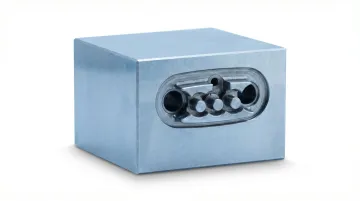
The primary quantitative claim supporting this substitution: Type III anodized surfaces reach HRC 65-70 versus stainless steel at HRB 70-80 (approximately HRC 20-25 equivalent), meaning the anodized surface is harder than the stainless steel it replaces.
Stainless steel remains the required material for food-contact surfaces under 3-A Sanitary Standards, pharmaceutical processing equipment, and applications where ultimate tensile strength exceeds aluminum alloy capabilities.
Getting the Most from Either Material
Material selection only gets you partway there — execution determines whether parts actually perform to spec. Surface treatment quality, machining tolerances, and finishing consistency all affect real-world durability. CNC Programming Solutions handles Type III anodizing, bead blasting, and powder coating in-house, covering the full process from raw stock to finished component for both aluminum and stainless steel parts.
Frequently Asked Questions
Which is better, hard anodized or stainless steel cookware?
Neither is universally superior — it depends on the application. Hard-anodized aluminum excels where lightweight construction and thermal performance matter. Stainless steel wins on durability, chemical resistance, and long-term stability, making it the go-to for harsh environments and compliance-driven specifications.
Is hard anodised cookware safe to use?
The hard-anodized layer is inert and non-reactive under normal conditions. However, damage to the surface can expose the reactive aluminum core. In industrial applications, the same principle applies—maintaining surface integrity is critical to preserving both corrosion protection and performance.
What is the healthiest cookware to use?
Stainless steel — particularly 316 grade — is non-reactive and chemically stable across varied conditions. Hard-anodized surfaces are also safe when intact, but performance depends on the quality and thickness of the oxide layer.
Which material performs better under industrial stress conditions?
Stainless steel is the standard choice for high-stress industrial environments due to its resilience, mechanical strength, and heat resistance. Hard-anodized materials suit applications where lighter weight and uniform heat distribution are priorities — thermal management components and aerospace housings being common examples.
Which is better, hard anodized or nonstick?
Hard-anodized is a base material treatment; nonstick is a surface coating applied on top. Hard-anodized surfaces are more durable and hold up longer under stress. In manufacturing, PTFE and similar nonstick coatings serve specific purposes — friction reduction or mold release — rather than structural protection.