Introduction
You've just finished CNC machining a precision aluminum part — it meets spec, tolerances are tight, and the geometry is flawless. Now comes the question: should you anodize it? This single finishing decision affects upfront cost, service life, surface hardness, and whether the part survives its deployment environment. For many manufacturers, this isn't a trivial add-on — it's a strategic choice.
The tradeoff isn't always obvious. Non-anodized aluminum offers a cost-effective baseline with natural corrosion resistance and excellent machinability. Anodized aluminum delivers measurable, documented gains:
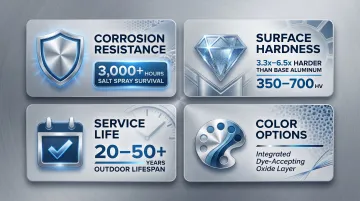
- 3,000+ hours of corrosion resistance in ASTM B117 salt spray testing (AAMA 611 Class I)
- 3.3x to 6.5x surface hardness increase over base alloy
- 20–50+ year outdoor service life without maintenance
Those gains come at a price — both in cost and dimensional impact.
This article covers the side-by-side comparison, breaks down the material science and practical use cases for each option, and provides a clear decision framework for engineers and production managers choosing between anodized and non-anodized aluminum.
Key Takeaways
- Non-anodized (mill finish) aluminum retains only a 2–4 nm natural oxide layer that forms on exposure to air — cost-effective but limited in protection
- Anodized aluminum builds a controlled oxide layer up to 17,000 times thicker via electrochemical treatment, with superior corrosion resistance and surface hardness
- Anodizing adds 0.0001"–0.001" per side (Type II) or up to 0.00225" per side (Type III hard anodize); factor this into tolerance planning
- Choose non-anodized for indoor, budget-sensitive, or high-conductivity applications
- Choose anodized for outdoor, high-wear, appearance-critical, or corrosive environments
Anodized vs. Non-Anodized Aluminum: Quick Comparison
| Factor | Non-Anodized | Anodized |
|---|---|---|
| Cost | Lower upfront cost; no secondary finishing required | Higher cost due to electrochemical treatment; scales with Type II vs. Type III |
| Corrosion Resistance | Modest protection from thin natural oxide; vulnerable in wet, salty, or acidic environments | Durable barrier against corrosion; survives 3,000+ hours salt spray (AAMA 611 Class I) |
| Surface Hardness | Softer surface prone to scratches and abrasion; suitable where wear isn't a concern | 3.3x–6.5x harder than base aluminum; significantly improved scratch/wear resistance |
| Aesthetics | Natural silver-gray mill finish; shows die marks and extrusion lines; limited color options | Uniform appearance; accepts dyes in wide color range; color integrated into oxide layer |
| Dimensional Impact | No change after machining; final dimensions match CNC program output | Adds 0.0001"–0.001" per side (Type II); more for Type III — factor this into CNC tolerances before finishing |
What is Non-Anodized Aluminum?
Non-anodized aluminum — also called mill finish or raw aluminum — is aluminum in its natural state after forming processes like rolling, extrusion, or CNC machining. No additional surface treatment is applied. Upon exposure to air, a thin aluminum oxide layer forms naturally, typically 2–4 nanometers thick. This layer provides modest protection but is chemically weak and limited in thickness.
Key material properties for manufacturing:
- Lightweight and machinable — easier to cut than treated aluminum, with less tooling wear and cleaner finishes
- Thermally and electrically conductive — the untreated surface preserves full conductivity, making it suitable for heat sinks and electrical housings
- Passively corrosion-resistant — the thin natural oxide offers basic protection in controlled indoor environments
Limitations:
- Thin oxide breaks down in acidic, alkaline, or high-humidity environments
- Surface is vulnerable to scratching and cosmetic damage
- Degrades faster in outdoor or high-contact applications without additional treatment
Use Cases of Non-Anodized Aluminum
Non-anodized aluminum works best when parts won't face harsh environments — or when a downstream finishing step is already planned. Common applications include:
- Internal brackets and structural frames where aesthetics and surface hardness aren't priorities
- Electrical components and heat sinks where conductivity must be preserved
- Prototypes and short-run production where finishing costs exceed the production budget
- Parts that will be painted or powder coated as a separate downstream step — where anodizing would be redundant
Dominant industries:
- Aerospace (structural frames and internal components)
- Consumer electronics chassis requiring conductivity
- Automotive interior components
- HVAC systems
- High-volume industrial parts where cost efficiency drives material selection
What is Anodized Aluminum?
Anodized aluminum is aluminum that has undergone anodization: an electrochemical process where the part is submerged in a sulfuric acid bath and exposed to an electric current. This forces accelerated oxidation, building a thick, hard anodic aluminum oxide (AAO) layer that is chemically bonded to the surface, not merely coated on it. Unlike paint or plating, the anodic layer cannot chip or peel.
The measurable outcome: The AAO layer is dramatically thicker than natural oxidation. Manufacturers can control thickness precisely by adjusting bath time, temperature, and current strength.
Anodizing types (per MIL-A-8625F):
| Type | Electrolyte | Thickness Range | Primary Use |
|---|---|---|---|
| Type II (Standard) | Sulfuric acid | 0.00007–0.0010 in. (1.8–25 microns) | General purpose, decorative, dye-accepting |
| Type III (Hard Anodize) | Sulfuric acid (cold, high current) | 0.0005–0.0045 in. (12.7–114 microns) | Maximum wear/abrasion resistance |
Core operational benefits:
- Improved corrosion resistance: AAMA 611 Class I anodized parts survive 3,000 hours of salt spray testing, far exceeding bare aluminum
- Surface hardness increase: Type III hardcoat achieves 350–700 HV (Vickers), approximately 3.3x to 6.5x harder than base 6061-T6 aluminum (107 HV)
- Low maintenance requirements: Anodized surfaces last 20–50+ years outdoors with only periodic cleaning
- Color and aesthetic options: The porous oxide layer accepts dyes before sealing, allowing integrated color that won't chip
Anodizing is also non-reactive and electrically insulating, making it suitable for food-contact applications (cookware, food processing equipment) and any application where parts must not conduct electricity or react with chemicals.
CNC Programming Solutions offers anodizing alongside bead blasting, vibe deburring, and powder coating, so parts can move from machining to finished coating within a single production workflow.
Use Cases of Anodized Aluminum
Those benefits translate directly into real-world applications — but timing matters in production. Anodized aluminum is applied after all machining, drilling, and tapping operations are complete. The hardened surface resists cutting, and the added layer affects final dimensions. CNC programs for tight-tolerance parts should account for anodize build-up in critical zones.
Dominant industries:
- Architectural facades and window systems (AAMA 611 Class I coating for decades of outdoor performance)
- Marine hardware exposed to saltwater and salt spray
- Aerospace exterior components requiring lightweight corrosion protection
- Consumer electronics — Apple uses anodized aluminum for MacBook and Apple Watch enclosures for durability and heat dissipation
- Automotive exterior trim in harsh weather environments
- Medical devices needing non-reactive, sterilization-compatible surfaces
- Sporting goods that absorb sweat, moisture, and repeated handling
Anodized vs. Non-Anodized Aluminum: Which Should You Choose?
The right choice depends on four key variables: operating environment, surface performance requirements, aesthetic expectations, and budget constraints. Getting this right upfront avoids costly rework — especially when downstream processes like anodizing affect final dimensions.
Environment-Driven Recommendation
If the part will face saltwater, UV exposure, high humidity, acidic chemicals, or high-traffic physical contact, anodized aluminum is the clear choice. The performance gap is quantifiable: AAMA 611 Class I anodized aluminum must survive 3,000 hours of ASTM B117 salt spray testing with minimal pitting — a standard that would destroy the thin natural oxide of non-anodized aluminum within a fraction of that time.
Performance vs. Cost Trade-Off
For indoor structural components, prototypes, electrical housings, or parts that will receive a secondary coating, non-anodized aluminum provides equivalent structural performance at lower cost. Anodizing pays back its premium primarily in environments where surface degradation would otherwise require frequent replacement or maintenance.
CNC Machining-Specific Recommendation
Always machine to final dimensions first, then anodize. Anodizing adds material to all exposed surfaces:
- Type II: Approximately 0.000035"–0.0005" per side
- Type III: Approximately 0.00025"–0.00225" per side (nominal 0.001")
Per MIL-A-8625F, dimensional build-up equals approximately one-half (1/2) of the total coating thickness per surface. For 60-degree threads, the pitch diameter will increase 4 times the surface growth.
When CNC programs are written with anodizing tolerances built in from the start, those dimensional shifts are accounted for before the first cut — not discovered after the part fails inspection. CNC Programming Solutions handles exactly this kind of tolerance-aware programming as part of its machining service workflow.
Situational Summary
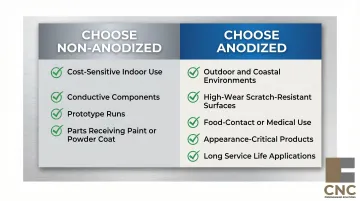
Choose non-anodized aluminum for:
- Cost-sensitive indoor applications
- Conductive components (electrical housings, heat sinks)
- Prototype runs and short-term testing
- Parts that will be painted or powder coated downstream
Choose anodized aluminum for:
- Outdoor exposure and coastal environments
- High-wear surfaces requiring scratch resistance
- Food-contact or medical applications
- Appearance-critical consumer products
- Any part where long service life must justify higher upfront cost
Conclusion
Neither option is universally superior. Non-anodized aluminum is the right tool for applications where cost efficiency, conductivity, and machinability take priority. Anodized aluminum delivers measurable return in environments demanding corrosion protection, surface hardness, and aesthetic durability. The decision hinges on where the part lives and how long it needs to perform.
Choosing anodized aluminum in high-exposure environments reduces replacement cycles, maintenance downtime, and surface touch-up costs. Choosing non-anodized in controlled environments avoids unnecessary finishing costs that don't translate to measurable performance gains. For teams that need both decisions handled in one place, CNC Programming Solutions offers anodizing as part of a complete machining-to-finish workflow — covering everything from raw material to final component with consistent quality control at each stage.
Frequently Asked Questions
Is anodized aluminum better than aluminum?
Anodized aluminum is the same base metal with an enhanced surface — not a categorically superior material. It outperforms non-anodized aluminum in corrosion resistance, hardness, and aesthetics, but non-anodized is preferred when conductivity, lower cost, or further processing (like painting) is needed.
Can a fingernail scratch anodized aluminum?
No. A fingernail has a hardness of approximately 2.5 on the Mohs scale, while the anodic oxide layer is significantly harder than base aluminum. Type III hardcoat anodizing achieves 350–700 HV, making it highly scratch-resistant. However, hard abrasives or metal tools can still damage the surface if force is applied.
What is the 7/20 rule for anodizing?
The "7/20 rule" describes how the anodic oxide layer grows both into and outward from the aluminum surface. Type II anodizing typically grows approximately 2/3 inward and 1/3 outward; Type III is closer to a 50/50 ratio. Both affect final part dimensions and must be factored into CNC machining tolerances.
Does anodizing affect the dimensions of CNC machined parts?
Yes. Anodizing adds material to all exposed surfaces — typically 0.0001" to 0.001" per side for Type II, and more for Type III hard anodize (up to 0.00225" per side). Per MIL-A-8625F, dimensional build-up equals approximately one-half of the total coating thickness per surface.
Can anodized aluminum be repaired or re-anodized?
Damaged anodized surfaces generally cannot be spot-repaired. The anodic layer must be chemically stripped and the entire part re-anodized to restore a uniform finish. This process removes consumed base metal, leaving the part undersized and potentially out of tolerance.
How long does anodized aluminum last compared to non-anodized aluminum?
Properly anodized architectural aluminum typically lasts 20 to 50 years or more in outdoor environments, depending on coating thickness, alloy selection, and sealing quality. Non-anodized aluminum degrades faster in humid, coastal, or chemically active environments without additional protective coatings, often requiring maintenance or replacement within a few years.