
Precision machining is often discussed in terms of equipment specifications and micrometer-level tolerances. But its real value in medical applications appears in patient outcomes, regulatory approval timelines, and production reliability. Medical device recalls reached 1,059 events in 2024, the highest level in four years, with manufacturing problems alone affecting 28.6 million units. Each failure represents a breakdown in process control—and precision machining, executed correctly, is the first line of defense.
This article explains why precision machining is operationally critical for medical devices: the three key advantages it delivers, what goes wrong without it, and how manufacturers can extract its full value.
Key Takeaways
- Precision machining produces medical components to tolerances as tight as ±0.0001", where even minor deviations cause device failure or patient harm
- Tight tolerances, biocompatible material handling, and regulatory compliance support are the three non-negotiable requirements precision machining delivers
- Complex geometries in implants and surgical tools require advanced multi-axis CNC programming, not just capable machines
- Skipping precision machining leads to rejected parts, failed inspections, costly recalls, and FDA enforcement actions
- Shops that build precision into every process step — not just final inspection — produce components that pass audits and protect patients
What Is Precision Machining for Medical Devices?
Precision machining is a subtractive manufacturing process that removes material to create components meeting extremely tight dimensional tolerances, often well beyond what standard machine shops can achieve. In medical device manufacturing, tolerances can reach ±0.0001", and surface finishes must meet biocompatibility requirements that prevent adverse tissue reactions.
Where Precision Machining Applies in Medical Manufacturing
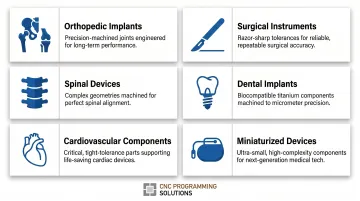
The process serves critical roles across medical device categories:
- Orthopedic implants: Hip and knee femoral components, acetabular cups, bone plates, and bone screws
- Surgical instruments: Scalpels, forceps, retractors, and cutting tools requiring sharp edges and precise geometry
- Spinal devices: Interbody fusion cages, pedicle screws, and rods
- Dental implants: Abutments and implant bodies
- Cardiovascular components: Device housings, connectors, and internal mechanisms
- Miniaturized devices: Pacemaker components, insulin pump parts, and diagnostic equipment
Surface finish requirements vary by application. According to Criterion Precision, femoral head implants require surface roughness of Ra 0.010-0.015 µm, while surfaces finished to Ra 0.05 µm may trigger osteolysis and premature failure. For surgical instruments, surfaces rougher than Ra 0.8 µm become reservoirs for biofilm formation, compromising sterilization.
A System, Not Just a Machine
Precision machining combines advanced equipment (multi-axis CNC milling, EDM, Swiss machining) with expert CNC programming and rigorous quality control. The programming layer is where much of the real work happens — CNC Programming Solutions' programmers build machining strategies specifically optimized for demanding biocompatible materials, accounting for tool paths, feeds, and tolerances that off-the-shelf programs miss.
The equipment executes the program, but a poorly written program running on a 5-axis machine still produces out-of-tolerance parts. Precision machining achieves device safety, longevity, and regulatory clearance through the entire system working together — not equipment specs alone.
Key Advantages of Precision Machining for Medical Devices
The advantages below tie to real operational and clinical outcomes—patient safety, regulatory approval, and production efficiency—not just theoretical manufacturing benefits.
Tight Tolerance Compliance Directly Protects Patient Safety
Medical components implanted in or used on the human body must fit exactly as designed. A femoral head that doesn't seat precisely in an acetabular cup creates friction, accelerating wear and generating debris that triggers inflammatory responses. A bone screw with rough edges or undercut threads damages surrounding tissue during insertion, increasing infection risk and compromising fixation strength.
How precision CNC machining creates this advantage: Programmed toolpaths execute identical cuts, angles, and passes on every part, eliminating human fatigue and variation. Multi-axis machines (4-axis and 5-axis) reach complex curved geometries—like hip joint articulating surfaces—without repositioning, maintaining dimensional integrity throughout the machining cycle.
Tight tolerance parts reduce post-surgical complications, revision surgeries, and device recalls. A systematic review of 9,952 revision total hip arthroplasty cases found an overall re-revision failure rate of 13.21%, with aseptic loosening accounting for 23.19% of failures—a failure mode directly influenced by implant bearing surface quality and dimensional accuracy.
The financial stakes are equally high. Individual major recall events cost $10M–$600M, and industry-wide recall expenses reach up to $5 billion annually.
Tolerance control also shapes production economics directly. A part that doesn't meet tolerance on the first pass either gets scrapped or requires costly rework. McKinsey research found that routine internal quality failures consume 2.1% of annual sales in the medical device industry.

KPIs impacted:
- First-pass yield rate
- Scrap and rework rate
- Post-market complaint rate
- Revision surgery incidence linked to device fit
When this advantage matters most: Highest impact in Class II and Class III devices (implants, life-sustaining devices) where tolerance failures have direct patient consequences, and in high-volume production runs where variance compounds at scale.
Reliable Machining of Biocompatible Materials Enables Safe, Durable Devices
Dimensional accuracy is only part of the equation. The materials themselves present a separate challenge.
The FDA mandates specific biocompatible materials in medical devices—surgical-grade stainless steel (316L, 17-4), titanium (Grade 5, Grade 23), cobalt chromium, PEEK, and medical-grade plastics. These materials must be safe for human tissue contact, sterilizable, and mechanically durable. They're also genuinely difficult to machine.
Titanium work-hardens under heat, generating cutting temperatures that can exceed 1,000°C. Stainless steel forms built-up edge on cutting tools, degrading surface finish. Research on cobalt chromium machining shows that 70% of cutting heat remains at the tool-workpiece interface, and surface hardness can increase over 100% due to work hardening during aggressive cutting. PEEK requires precise feed rates and controlled temperatures to avoid delamination or dimensional distortion.
How precision machining addresses this: Proper CNC programming controls cutting speeds, feed rates, and coolant delivery to manage heat, prevent work hardening, and maintain surface integrity. Expert programmers develop toolpaths specifically for challenging biocompatible materials, reducing tool wear, preventing surface contamination, and achieving the smooth finishes required for implant-grade components.
Improperly machined biocompatible materials introduce surface defects, micro-burrs, or contamination that trigger adverse biological reactions once implanted. The DePuy ASR hip implant recall—involving approximately 93,000 units globally—shows what happens when metal-on-metal bearing surfaces fail:
- 5-year revision rates reached 12–13%
- Cobalt and chromium ion release caused metallosis and pseudotumors
- Settlements exceeded several billion dollars
Beyond patient outcomes, proper machining extends tool life and reduces per-part material cost. Medical-grade titanium costs $35–$50/kg versus $1.00–$1.50/kg for stainless steel—a 20–50x premium. Scrap reduction through precision machining has outsized ROI on titanium and cobalt chromium components.
KPIs impacted:
- Surface roughness (Ra)
- Tool life and tool change frequency
- Material waste rate
- Biocompatibility test pass rate
When this advantage matters most: Most critical for implantable devices (Class III) where material purity and surface condition directly affect patient safety, and in production volumes where each part carries high material cost.
Built-In Support for Regulatory Compliance and Traceability
Material and dimensional control determine whether a device functions safely. Regulatory compliance determines whether it reaches the market at all.
Medical device manufacturing in the U.S. is governed by the FDA's Quality Management System Regulation (QMSR), which became effective February 2, 2026, incorporating ISO 13485:2016 by reference. These frameworks require documented processes, traceability of materials and operations, and evidence that parts are produced consistently to design specifications.
How precision machining creates this advantage: CNC programs are version-controlled, repeatable, and auditable. Each production run follows the same programmed instructions, making it straightforward to demonstrate process consistency to regulators. Combined with proper quality documentation, this supports Design History Files (DHFs), Device Master Records (DMRs), and corrective action processes required under QMSR.
Regulatory non-compliance leads to FDA warning letters, import holds, and product recalls. As of early September 2025, FDA issued 19 warning letters citing QSR violations—already exceeding many prior full-year totals, with CAPA (Corrective and Preventive Action) as the most frequently cited deficiency.
The direct cost of quality in medical devices is $26B–$36B annually (6.8%–9.4% of sales), with non-routine external failures (recalls, litigation) accounting for $7.5B–$9.5B of that total. Consistent CNC programming also reduces re-validation burden when scaling production, because the process is already documented and repeatable.
KPIs impacted:
- Audit findings and non-conformances
- Time-to-market for new devices
- Recall rate
- Cost of quality (CoQ)
When this advantage matters most: Highest impact when introducing new devices to market (510(k) submissions, PMA applications), scaling from prototype to full production, or operating under FDA audit conditions.
What Happens When Precision Machining Is Skipped or Substandard
Skipping or cutting corners on precision machining produces predictable, documented failures across the manufacturing cycle:
- Implants that fail to seat correctly cause mechanical instability, accelerating wear and loosening — revision procedures carry 5x higher re-revision risk than primary surgeries
- Rough surface finishes harbor biofilm that resists sterilization; micro-burrs trigger tissue trauma and sustained inflammatory responses
- Scrap and rework costs can reach up to 40% of conversion cost per manufacturing site — a significant drain when the base materials are titanium or cobalt chromium
- Non-conformances trigger CAPA investigations averaging 40-55 days, delaying regulatory submissions and pushing revenue timelines back by quarters, not weeks
- Without consistent process control and programming, each production run introduces new variation, making reliable volume output economically unviable
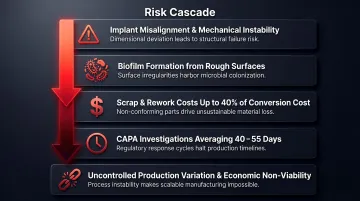
These failures compound quickly. One non-conforming batch triggers investigation time, potential regulatory notification, and customer audits — and in medical device manufacturing, lost confidence rarely comes back without significant remediation effort.
How to Get the Most Value from Precision Machining in Medical Device Production
Precision machining delivers highest value when treated as a system, not just a machine capability. Three conditions matter most:
CNC programming quality determines part quality. The machine executes only what the program instructs. A poorly written program running on a 5-axis machine still produces out-of-tolerance parts. Consistent toolpath strategy, proper feed and speed selection for each biocompatible material, and version-controlled programs make precision repeatable across production runs. CNC Programming Solutions develops optimized programs for machines with up to 5 axes, building that repeatability directly into the manufacturing process.
Close the loop between machining and finishing. Precision doesn't end when the part leaves the spindle. Surface finishing processes — vibe deburring, bead blasting, and anodizing — are part of the quality chain for medical devices. Dimensional accuracy means little if surface condition doesn't meet implant or instrument standards. Keeping finishing in the same production workflow reduces handoff errors and maintains traceability across the full process.
Quality data should drive improvements, not paperwork. Dimensional inspection data, surface roughness measurements, and first-pass yield trends should feed back into program adjustments and process changes — not simply archived in a quality record. Continuous improvement cycles distinguish manufacturers who maintain regulatory standing from those who face enforcement actions.

Conclusion
Precision machining in medical device manufacturing carries direct consequences for patient safety, regulatory compliance, and production economics. Applied consistently, the discipline delivers compounding returns: tighter tolerance compliance reduces recalls, proper material handling improves biocompatibility outcomes, and built-in traceability accelerates FDA approval timelines.
The results depend on system alignment, not just machine capability. Expert CNC programming, material-specific strategies, and finishing quality each reinforce the others — gaps in any one area surface as defects, audit findings, or delayed clearances. With medical device recalls at a four-year high and FDA enforcement accelerating, manufacturers who treat precision as an ongoing operational commitment — not a one-time equipment investment — are the ones building the production reliability that keeps products on the market and patients safe.
Frequently Asked Questions
What is high precision machining?
High precision machining is a subtractive manufacturing process producing parts to extremely tight dimensional tolerances—often ±0.0001" or better—using advanced CNC equipment, expert programming, and rigorous quality control. It goes beyond standard CNC machining in the sophistication of tools, machines, and process control required.
What tolerances are required for medical device machining?
Tolerance requirements vary by device class. Implantable components may need tolerances as tight as ±0.0001", while surgical instruments or enclosures often allow slightly wider ranges. FDA and ISO 13485 both require documented justification for specified tolerances based on intended use and risk analysis.
What materials are used in precision medical device machining?
Common FDA-approved biocompatible materials include surgical-grade stainless steel (316L, 17-4), titanium (Grade 5 and Grade 23), cobalt chromium, and medical-grade plastics such as PEEK, polypropylene, and polyethylene. Material selection depends on device class, implant duration, mechanical requirements, and sterilization method.
Can you CNC machine PEEK?
Yes. PEEK (polyether ether ketone) is CNC machinable and widely used in medical devices—spinal implants, bone plates, and surgical instruments—due to its biocompatibility, radiolucency, and strength. Precise feed rates, sharp tooling, and controlled cutting temperatures are required to avoid delamination or dimensional distortion.
How does precision machining support FDA regulatory compliance?
CNC machining produces repeatable, documented processes that directly support FDA QSR (21 CFR Part 820) and ISO 13485 requirements—covering Design History Files, Device Master Records, and CAPA. Consistent programming and quality records serve as auditable evidence during inspections and 510(k) submissions.
Which machine is best suited for high volume precision production?
Multi-axis CNC machining centers (4-axis and 5-axis) paired with Swiss machining for small-diameter components deliver the best combination of speed, repeatability, and tolerance capability for high-volume medical production. The right choice depends on part geometry, material, and volume—and CNC program quality matters as much as the machine itself.