Introduction
Engineering teams racing to validate designs face a costly reality: each day of prototype delay can run thousands of dollars, and traditional 3-axis machining only makes it worse. Multiple setups, manual repositioning, and compounding errors push timelines out and eat into margins before a single unit ships. 5-axis CNC machining solves this directly — complex geometries, undercuts, and contoured surfaces machined in a single setup, with no repositioning and no accumulated error.
The cost difference is concrete. A complex medical device prototype requiring 6 setups on a 3-axis machine ran $1,800 in machining plus $5,040 in rework. The same part on 5-axis: $2,400 total, zero rework. This guide breaks down the best 5-axis machining options for rapid prototyping in 2026 — covering capabilities, lead times, and what to look for before you commit.
Key Takeaways
- 5-axis CNC machining moves a cutting tool across five simultaneous directions, producing complex prototype geometries in fewer setups and cutting lead times vs. 3-axis methods
- Top services are evaluated on turnaround speed, tolerance capability, material range, DFM support, and industry certifications
- Top picks for 2026: Protolabs, Xometry, Fathom, and Hubs (Protolabs Network), each suited to different use cases
- Right-fit selection hinges on part complexity, tolerances, compliance needs (ISO, ITAR, AS9100), and sourcing model
Why 5-Axis CNC Machining is the Gold Standard for Rapid Prototyping
Why 5-Axis CNC Machining Outperforms 3-Axis for Complex Prototypes
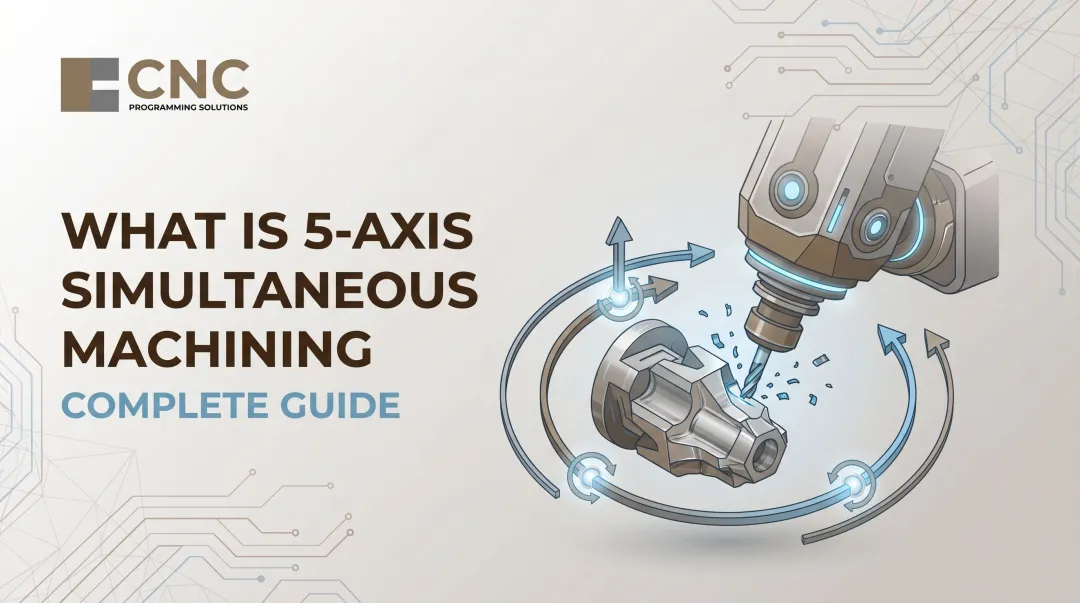
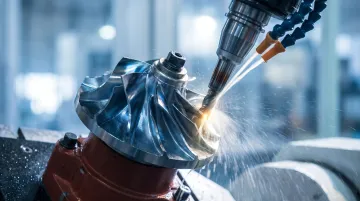
5-axis CNC machining moves a cutting tool or workpiece along five axes simultaneously: three linear axes (X, Y, Z) plus two rotational axes. The A-axis rotates about the X-axis, and the B-axis rotates about the Y-axis. This configuration allows the cutting tool to approach the workpiece from virtually any angle in a single setup.
For prototyping, that single-setup capability directly affects cost, timeline, and part quality. Machining complex surfaces, deep cavities, and multi-face parts without re-fixturing delivers three concrete advantages:
- Each 3-axis repositioning introduces approximately ±0.0002″ positioning error; across 5 setups, errors stack to ±0.001″ or more — eliminating setups eliminates that accumulation
- One aerospace nozzle assembly saw a 30% cost reduction by machining as a single monolithic part rather than four brazed components
- Compound angles, sculptured surfaces, and undercuts that 3-axis cannot produce without additional setups become straightforward
Beyond geometry, 5-axis machining supports a broad range of engineering-grade materials — aluminum, titanium, stainless steel, PEEK, Inconel — making it suitable for functional prototypes that must replicate production-grade performance, not just visual form.
The cost comparison makes the case clearly:
| Metric | 3-Axis | 5-Axis |
|---|---|---|
| Hourly rate | $75-$125/hr | $150-$325/hr |
| Setups for complex part | Up to 6 | 1-2 |
| Medical prototype total cost | $6,840 ($1,800 + $5,040 rework) | $2,400 (no rework) |
| Lead time (complex part) | 3 weeks quoted, 5 weeks actual | 2 weeks |
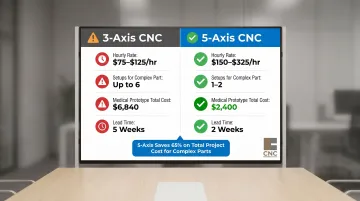
While 5-axis hourly rates run 2-3x higher than 3-axis, total project costs often favor 5-axis for parts with 4+ machined faces or positional tolerances tighter than ±0.002″.
Top 4 Best 5-Axis CNC Machining Services for Rapid Prototyping in 2026
Not every 5-axis machining service is built for speed, compliance, or complex geometries equally. These four were selected for verified turnaround performance, tolerance precision, DFM depth, and real-world outcomes in regulated industries.
Protolabs
Protolabs, founded in 1999, is a digital manufacturing service offering CNC machining, 3D printing, injection molding, and sheet metal fabrication through an automated cloud-based quoting and DFM platform. Its defining characteristic is speed — automated analysis cuts the quoting-to-machining cycle that typically takes days down to hours.
What sets Protolabs apart: AI-powered DFM feedback on uploaded CAD files flags undercuts, thin walls, and tool accessibility issues within hours. The company delivered a generatively designed part to NASA in 36 hours, demonstrating industry-leading turnaround. Protolabs scales directly from single prototype to low-volume production runs without requiring new vendor qualification.
| Feature | Specification |
|---|---|
| Lead Time | As fast as 1 business day |
| Standard Tolerance | ±0.005″ (0.13mm) |
| Precision Tolerance | ±0.002″ (0.051mm); reamed holes ±0.0005″ |
| Certifications | ISO 9001:2015, AS9100D, ITAR, NADCAP (coatings) |
| Surface Finish | 63 micro-in Ra (flat surfaces); 125 micro-in Ra (curved) |
Best for: Engineering teams needing fastest possible prototype iterations with automated DFM feedback and proven aerospace/medical compliance.
Xometry
Xometry operates an AI-powered on-demand manufacturing marketplace connecting customers with a vetted global network of 5-axis CNC machining suppliers, offering instant quoting across 50+ metals and plastics.
What sets Xometry apart: Algorithmic supplier matching delivers competitive pricing through its 5,000+ global manufacturing suppliers across 50+ countries. The unified dashboard manages CNC prototyping alongside sheet metal and urethane casting in a single workflow. Xometry provides compliance-ready material certifications (RoHS, REACH, FDA resins) for regulated industries.
| Feature | Specification |
|---|---|
| Platform Type | AI-powered marketplace (network model, not owned factories) |
| Lead Time | Starts at 3 business days |
| Standard Tolerance | ±0.005″ (metals); ±0.010″ (plastics) |
| Precision Tolerance | Sub ±0.001″ with GD&T callouts |
| Material Range | 50+ materials including PEEK (3 grades), Inconel, titanium |
| Certifications | ISO 9001:2015, ISO 13485, AS9100D, ITAR, CMMC Level 2 |
Best for: Teams needing material diversity and geographic flexibility with competitive pricing through supplier competition — especially when sourcing multiple part types across CNC, sheet metal, and casting in one workflow.
Fathom
Fathom is an engineering-focused rapid prototyping and manufacturing partner offering hybrid capabilities—additive manufacturing, 5-axis CNC machining, and injection molding—with deep expertise in engineering-grade materials and complex geometries for OEMs and hardware startups.
What sets Fathom apart:
- On-site DFM co-engineering consultations for joint failure mode analysis
- Machines titanium, Inconel, medical-grade PEEK, and 17-4PH stainless to tight tolerances across 8 US-based facilities
- Print-to-CNC finishing workflow pairs DMLS near-net shapes with 5-axis finishing for internal geometries impossible with CNC alone
| Feature | Specification |
|---|---|
| Core Technologies | 3-axis, 4-axis, 5-axis CNC, CNC turning, wire EDM, sinker EDM, DMLS |
| Target Industries | Aerospace (AS9100D), Medical (ISO 13485), Defense (ITAR) |
| Certifications | ISO 9001:2015, ISO 13485:2016, AS9100D, ITAR, NIST 800-171 |
| DFM Support | On-site engineer integration for co-engineering and failure mode analysis |
| Manufacturing Model | Owned US facilities (Made in USA) |
Best for: Aerospace, defense, and medical prototyping requiring full compliance traceability, hybrid additive-CNC workflows, and engineering consultation on complex geometries.
Hubs (Protolabs Network)
Hubs, now operating as Protolabs Network, is a global digital manufacturing platform founded in 2013 and acquired by Protolabs in January 2021 for $280 million. The platform connects customers with a vetted supply base for CNC machining, 3D printing, and sheet metal with AI-powered instant quoting and lead times as fast as 5 business days.
What sets Hubs apart: Tolerances down to ±0.020 mm, access to 100+ material and finish combinations, and ISO 9001 plus AS9100D certification across a network of 250+ vetted partners. The platform has served over 100,000 businesses including Airbus, NASA, Philips, Audi, and Intel. Distributed engineering teams get consistent quality across global suppliers without managing separate vendor relationships.
| Feature | Specification |
|---|---|
| Lead Time | From 5 business days |
| Tolerance Range | Down to ±0.020 mm (±0.001″) |
| Certifications | ISO 9001:2015, AS9100D |
| Materials & Finishes | 100+ combinations across metals and engineering plastics |
| Network Scale | 250+ vetted partners globally serving 100,000+ businesses |
Best for: Mid-complexity prototypes where global sourcing, price competition, and proven enterprise client track record matter more than owning the manufacturing facility.
How We Chose the Best 5-Axis CNC Machining Services for Rapid Prototyping
A common mistake is choosing a vendor on price or brand name alone. What actually matters is whether their 5-axis capability, DFM support, and turnaround speed align with your specific prototyping stage—concept validation, functional testing, or pre-production bridge.
Key selection factors used:
- 5-axis capability - Simultaneous axis machining, not just indexed 3+2 positioning
- Material range - Engineering-grade metals (titanium, Inconel, stainless) and plastics (PEEK, PEI, polycarbonate)
- DFM feedback quality - Automated AI analysis vs. on-site engineering consultation
- Achievable tolerances - Standard ±0.005″ vs. precision sub-±0.001″ capabilities
- Industry certifications - ISO 9001, AS9100D, ISO 13485, ITAR registration
- Lead time reliability - Verified delivery times for prototype quantities
One factor that doesn't appear on spec sheets: CNC programming quality. Even on identical 5-axis hardware, expert toolpath programming directly impacts surface finish, cycle time, and part accuracy through optimized feeds, speeds, and axis utilization. Softer materials like nylon, HDPE, and PEEK require different tooling strategies to hold the same tolerances achievable in steel or aluminum. Shops that apply specialized 5-axis programming expertise — whether in-house or through contracted support like CNC Programming Solutions — consistently get more from the same hardware.
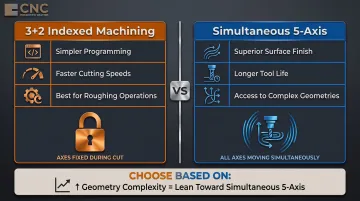
3+2 indexed vs. simultaneous 5-axis: 3+2 machining positions the part using rotary axes, locks them, then performs 3-axis cutting. It's simpler to program, offers faster cutting speeds, and works well for roughing operations. Simultaneous 5-axis moves all five axes at once, delivering better surface finishes, longer tool life, and the ability to reach difficult geometries—but requires a full CAM system and can be slower. Choose based on your geometry requirements, not just capability lists.
Conclusion
The right 5-axis CNC machining partner comes down to technical fit, not name recognition. Match the provider's tolerance capability, material expertise, and DFM support to your prototype stage and compliance requirements before committing.
Beyond technical specs, evaluate:
- Scalability — can this partner bridge from 5 prototype units to 500 production runs?
- Data transparency — version control, material traceability, and audit trails
- Total cycle time — not just the quoted lead time, but setup, iteration, and delivery combined
The 5-axis hourly rate may run double that of 3-axis, but total project cost frequently favors 5-axis once you account for eliminated setups, reduced rework, and lower scrap rates.
If your prototyping workflow depends on tight-tolerance CNC programming rather than a full-service machining bureau, that's a separate but equally important consideration. CNC Programming Solutions develops CNC programs for multi-axis machines—including up to 5-axis configurations—and supports production runs with finishing services such as bead blasting, vibe deburring, anodizing, and powder coating. Call 405-714-3714 or email cncsolutions22@gmail.com to discuss how optimized programming can tighten your next prototype cycle.
Frequently Asked Questions
What makes 5-axis CNC machining better than 3-axis for rapid prototyping?
5-axis machining eliminates multiple setups required in 3-axis by accessing all faces of a part in a single fixture. This reduces positioning errors, cuts total cycle time, and enables complex geometries that 3-axis cannot produce without multiple expensive re-fixturings.
How fast can 5-axis CNC machining deliver prototype parts?
Lead times vary by provider and complexity. Protolabs delivers simple CNC-machined prototypes in as fast as 1 business day, while Xometry starts at 3 business days and Hubs from 5 business days. Complex multi-material or tight-tolerance parts may take 5-10 business days.
What materials can be used in 5-axis CNC rapid prototyping?
Common metals include aluminum alloys, titanium, stainless steel, and Inconel. Engineering plastics include PEEK (continuous operation up to 260°C), PEI/Ultem, polycarbonate, nylon, and POM. Choose metals for structural or thermal validation prototypes; plastics work well for form-and-fit checks.
How much does 5-axis CNC rapid prototyping cost?
Costs depend on machine time, material, part complexity, and setup requirements. 5-axis hourly rates run $150-$325/hr vs. $75-$125/hr for 3-axis. The higher hourly rate is frequently offset by fewer setups — for complex geometries, total part cost often matches or beats 3-axis.
What tolerances can 5-axis CNC machining achieve for prototypes?
High-end 5-axis CNC systems achieve tolerances from ±0.005″ (standard) to ±0.002″ (precision) depending on machine, material, and part geometry. Reamed holes can reach ±0.0005″. Simultaneous 5-axis motion maintains tighter consistency across complex surfaces than indexed 3+2 approaches.
Which industries benefit most from 5-axis CNC rapid prototyping?
Aerospace, medical devices, automotive, and industrial automation benefit most — these sectors prototype turbine blades, implants, engine components, and precision housings where geometry complexity and tight tolerances are non-negotiable from day one.