Introduction
In aerospace manufacturing, there is no room for error. A single faulty component can compromise an entire mission, endanger lives, and cost millions. Choosing the right CNC parts manufacturer isn't just a procurement decision—it's a decision with direct consequences for airworthiness, crew safety, and program cost.
The global precision machining market reached $126.99 billion in 2025 and is projected to hit $224.13 billion by 2034, driven largely by aerospace and defense demand. Aircraft production backlogs, expanding commercial fleets, and growing defense and space exploration programs continue to fuel steady demand for precision-machined engine and structural components.
This article evaluates the top aerospace CNC parts manufacturers based on capabilities, certifications, and industry track record—criteria that reflect what aerospace procurement teams actually verify before awarding contracts.
Key Takeaways
- Aerospace CNC machining requires ±0.001-inch tolerances and strict adherence to AS9100D, NADCAP, and ISO 9001
- Key machined parts include engine components, structural frames, landing gear assemblies, and avionics housings
- Multi-axis machining (4-axis and 5-axis) enables complex geometries with fewer setups and higher precision
- AS9100D and NADCAP certifications are baseline qualifiers; always verify them before engaging any supplier
- Qualified manufacturers combine materials expertise, multi-axis programming capability, and full quality traceability
Overview of CNC Machining in the Aerospace Industry
CNC machining in aerospace is computer-controlled subtractive manufacturing for high-precision components. Structural, propulsion, and avionics parts are produced from materials like titanium, Inconel, aluminum alloys, and high-performance plastics.
Aerospace machining presents unique challenges:
- Tolerances start at ±0.001 inches (25 micrometers) for standard work and tighten to ±0.0002 inches (0.005 mm) for critical features — compared to ±0.010 inches in general manufacturing
- Titanium Ti-6Al-4V, Inconel 718, and hardened nickel superalloys demand specialized tooling and machining expertise that most shops lack
- AS9100 Rev D mandates full identification and traceability across the supply chain, alongside ISO 9000, MIL-SPEC, and FAA requirements
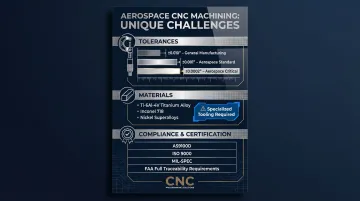
Aerospace CNC parts manufacturers range from Tier 1 OEM suppliers producing complete assemblies to specialized contract shops handling complex, low-volume precision components. The manufacturers profiled below represent both tiers, selected based on certifications held, materials capability, and documented track records in flight-critical production.
Top Aerospace CNC Parts Manufacturers: Industry Leaders
The manufacturers below were selected based on certifications held, multi-axis machining capability, aerospace-specific client base, quality management systems, and breadth of materials handled.
Precision Castparts Corp (PCC)
Precision Castparts Corp is one of the world's largest aerospace component manufacturers, owned by Berkshire Hathaway since January 2016. PCC produces investment castings, forgings, and precision machined parts for commercial aircraft, military platforms, and space systems.
What sets PCC apart: Massive multi-axis CNC machining infrastructure, AS9100 and NADCAP certifications for critical processes, and supply relationships with Boeing, Airbus, and GE Aviation for engine and airframe components. The company operates over 3 million square feet of manufacturing space across three continents, with gantry profilers with bed lengths up to 228 feet and long bed machining up to 308 feet.
| Certifications | AS9100 and NADCAP approvals for critical aerospace processes |
|---|---|
| Key Capabilities | 3, 4, and 5-axis prismatic and long bed machining; investment casting; precision forging; complex component assembly; parts up to 40 meters long |
| Primary Parts Produced | Engine structural components, turbine airfoils, fasteners, ribs, spars, major frames, bulkheads, landing gear components, flight-critical assemblies |
Materials handled: Aluminum, titanium, stainless steel grades, nickel-based alloys, and specialty alloys at 50+ Rc hardness.
Documented customers: GE (TF-39, CF6-50, CF6-80C engines), Pratt & Whitney (PW2037), Rolls-Royce, Boeing (747, 757, 767 programs), Airbus.
Triumph Group
Triumph Group is a dedicated aerospace manufacturer producing machined structures, engine components, aircraft interiors, and maintenance services for commercial and military customers. Acquired by Warburg Pincus and Berkshire Partners in July 2025, Triumph is now privately held and operates through 5 operating companies with 28 locations in 12 U.S. states and 7 foreign countries.
Core differentiators: Vertically integrated capabilities spanning design through final assembly, strong presence in military and commercial OEM supply chains, and AS9100-certified facilities across multiple manufacturing sites. Q4 fiscal year 2025 net sales reached $377.9 million.
| Certifications | AS9100 Rev D, ISO 9001:2015, NADCAP accreditations (Heat Treat, Chemical Processing, NDT, Nonconventional Machining, Brazing), FAA Part 21, FAA Part 145 Repair Station certifications |
|---|---|
| Key Capabilities | CNC milling and turning, structural fabrication, component assembly, MRO services, electronic fuel controls, landing gear systems, actuation and control systems, thermal solutions |
| Primary Parts Produced | Engine nacelles, structural frames, avionics housings, fuselage sub-assemblies, gearboxes, electric brakes, nose wheel steering systems |
Documented customers: Boeing, Lockheed, Sikorsky, Gulfstream, Bell, Northrop-Grumman, Airbus, GE, Rolls-Royce, Pratt & Whitney, Honeywell, FedEx, UPS, Atlas. Military programs include V-22 Osprey, C-17 Globemaster III, and BAE M777 Howitzer.
Spirit AeroSystems
Spirit AeroSystems is a leading Tier 1 aerostructure manufacturer specializing in fuselage sections, wing systems, and nacelles for major commercial and defense aircraft programs including the Boeing 737 and Airbus A320 family. Boeing completed its acquisition of Spirit in December 2025.
What sets Spirit apart: Large-scale CNC machining of both metallic and composite structures, rigorous quality systems supporting multi-program production, and deep integration with major OEM supply chains.
Commercial and aftermarket operations are now integrated into Boeing Commercial Airplanes, while Spirit Defense operates as an independent subsidiary of Boeing Defense, Space & Security.
| Certifications | AS9100:D, ISO 9001:2015 (Intertek Certificate #056328-06), ISO 14001:2015 (Intertek Certificate #0141586) |
|---|---|
| Key Capabilities | Large-scale CNC machining, composite fabrication, structural assembly, fuselage manufacturing, wing systems production |
| Primary Parts Produced | Fuselage sections for 737 program; major structures for 767, 777, and 787 Dreamliner; fuselage, propulsion, and wing systems for Airbus and business aircraft |
Note: As Spirit is now a wholly owned Boeing subsidiary, procurement teams should verify current contracting pathways through Boeing.
Specialized Precision Shops
The manufacturers below operate at a different scale than the Tier 1 OEMs above, focusing on complex, tight-tolerance components for programs that require flexibility, faster turnarounds, or lower-volume production runs.
TJ Aerospace
TJ Aerospace is a specialized precision CNC machining job shop focused on high-accuracy, complex, tight-tolerance components for aerospace, defense, commercial, and medical industries. Founded in 2007 and based in Garden Grove, CA, the company operates a 49,000 sq ft facility with a second factory in Vietnam opened in 2023.
Why procurement teams use TJ Aerospace: Lean manufacturing approach with a proven track record in low-to-mid volume complex components, 5-axis capability across multiple machine platforms, and competitive lead times. Self-reported performance metrics: 98% quality, 97% on-time delivery, 100% customer satisfaction.
| Certifications | AS9100:2016 (AS9100D), ISO 9001:2015, ISO 13485:2016, ITAR compliant; Cage Code: 5WGW6; DUNS: 801918330; NAICS: 332710 |
|---|---|
| Key Capabilities | Precision CNC milling and turning (3, 4, and 5-axis); 5-axis waterjet cutting; electrochemical deburring; ultrasonic cleaning; laser marking; clean room assembly; lights-out manufacturing |
| Primary Parts Produced | High-complexity machined parts and sub-assemblies for aerospace and defense applications including structural components, brackets, housings, and custom hardware |
Equipment highlights: DMG MORI NTX 500/1000 (5-axis mill turn); HAAS UMC-750SS, UMC-1000SS (5-axis); OKK VM76R, VC-X350, VC-X500, VP9000-5AX, KCV-1000 (5-axis long bed); Flow Mach 500 Waterjet (5-axis).
Materials handled: Aluminum, titanium, Inconel, stainless steel, carbon steel, copper, brass, honeycomb panels, foam, phenolic, plastic, exotic materials.
Inspection capabilities: Hexagon Global Performance Silver CMM, Hexagon Absolute Arm 7-Axis, Keyence IM-7030 instant measurement system.
DEK (Shenzhen)
DEK is a China-based aerospace CNC machining service provider established in 2002, serving aerospace, medical, defense, and industrial sectors with precision machining of plastics and metals to demanding specifications. The company serves over 2,300 customers worldwide.
What sets DEK apart: Extensive equipment range covering milling, turning, EDM, and wire cutting — over 100 sets of advanced equipment in total — and an engineering team with direct experience in aviation and military part specifications. Buyers working with export-controlled designs should confirm ITAR applicability and applicable trade compliance requirements before engagement.
| Certifications | ISO 9001 (first passed in 2005), AS9100D, ISO 13485 |
|---|---|
| Key Capabilities | CNC milling, CNC turning, precision grinding, centerless grinding, CNC drilling, EDM, wire cutting, multi-material capability (metals and plastics); over 100 sets of advanced equipment |
| Primary Parts Produced | Precision aerospace parts including brackets, housings, structural components, custom machined hardware |
Additional services: Injection molding, die casting, sheet metal fabrication (laser cutting, bending, shearing, rolling, punching), vacuum casting, 3D printing (DMLS, SLA, SLS, FDM).
Materials handled: Aluminum, copper, magnesium, zinc, steel, various die-casting alloys, polyurethane resins, engineering thermoplastics.
Key Qualifications That Set Leading Aerospace CNC Manufacturers Apart
AS9100D Certification
Published by SAE International and the International Aerospace Quality Group (IAQG), AS9100D builds on ISO 9001:2015 with over 100 aerospace-specific requirements including:
- Operational risk management
- Configuration management
- Product safety and counterfeit parts prevention
- Enhanced traceability and first-article inspection requirements
Any manufacturer without AS9100D certification is effectively locked out of aerospace supply chains — no exceptions.
NADCAP Process Accreditation
Managed by the Performance Review Institute (PRI), NADCAP is a globally recognized accreditation program covering compliance for critical aerospace processes. Across 26 accreditation categories, the most relevant for CNC manufacturers include:
- Conventional Machining as a Special Process
- Nonconventional Machining
- Heat Treating
- Chemical Processing
- NonDestructive Testing (NDT)
- Welding, Coatings, Surface Enhancement
- First Article Inspection and Measurement
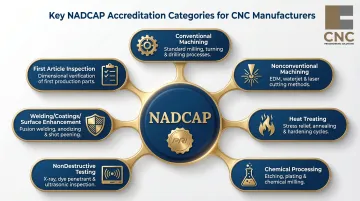
Manufacturers holding NADCAP approvals are pre-qualified for critical process work—saving procurement teams time and reducing risk.
Multi-Axis Programming Capability
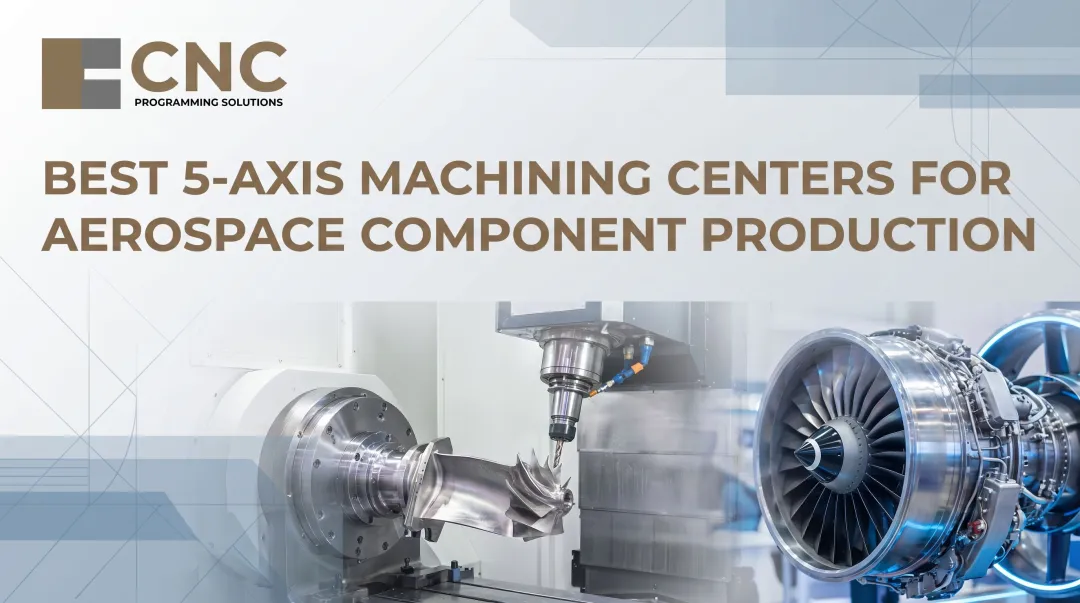
4-axis and 5-axis CNC machining enables complex geometries in fewer setups, directly improving dimensional accuracy and reducing the risk of handling-induced errors. Fewer repositioning steps mean tighter tolerances and shorter cycle times — both critical in aerospace production where rework is rarely an option.
How We Selected These Manufacturers
Not every shop that machines metal is equipped for aerospace work. The manufacturers featured here were evaluated on a defined set of criteria directly tied to aerospace production standards:
- Verified aerospace-industry certifications (AS9100D, NADCAP, ISO 9001)
- Demonstrated multi-axis machining capabilities (4-axis and 5-axis)
- Documented client relationships with aerospace OEMs or Tier 1 suppliers
- Materials handling range (titanium, Inconel, aluminum alloys)
- Market longevity and industry reputation
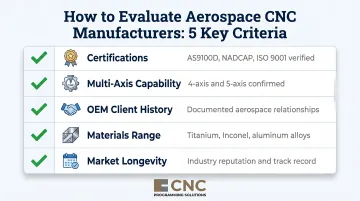
Meeting these criteria separates qualified aerospace suppliers from general-purpose machine shops. Still, even buyers with clear requirements make avoidable errors during selection. The most common ones to watch for:
- Overweighting brand name recognition over actual process certifications
- Ignoring whether the manufacturer holds NADCAP approvals for the specific processes needed
- Skipping verification that the supplier has worked with the specific material grade or part geometry your project requires
- Not assessing lead time reliability and quality reject rates
- Ignoring CNC programming capability for the required geometry and tolerance
Conclusion
The manufacturers profiled represent a cross-section of the aerospace CNC machining supply chain—from global Tier 1 aerostructure producers to specialized contract shops. The right choice depends on part complexity, volume, material, and required certifications rather than size alone.
Procurement and engineering teams should evaluate potential manufacturing partners on ongoing quality performance, scalability for production volume changes, and how well their CNC programming and process capabilities align with specific component requirements.
For shops and manufacturers working toward tighter aerospace-grade tolerances, programming quality is often the limiting factor. CNC Programming Solutions provides multi-axis CNC programming services—covering 4-axis milling through complex 5-axis programs—designed to improve cutting precision and production throughput without adding headcount.
Reach the team at 405-714-3714 or cncsolutions22@gmail.com to discuss your specific component requirements.
Frequently Asked Questions
What certifications should an aerospace CNC parts manufacturer have?
AS9100D is the core aerospace quality management certification, ISO 9001 provides the foundation, and NADCAP approval is required for special processes like heat treating, chemical processing, and NDT. A supplier holding all three is equipped for serious aerospace work.
What materials are most commonly used in aerospace CNC machining?
Common aerospace CNC materials include titanium alloys (Ti-6Al-4V), aluminum alloys (6061, 7075), nickel superalloys (Inconel 718), stainless steel, and high-performance plastics. Material choice is driven by weight, thermal performance, and structural load requirements.
What types of parts are CNC machined for aerospace applications?
CNC machining produces engine components (turbine discs, casings, blades), structural airframe parts (brackets, ribs, spars), landing gear components, avionics housings, and fluid system fittings. Nearly any metal part requiring tight tolerances can be CNC machined.
What tolerances can aerospace CNC machining achieve?
Aerospace CNC machining typically achieves tolerances of ±0.001 inches or tighter, with advanced multi-axis setups reaching ±0.0002 inches for critical features.
What is the difference between AS9100 and ISO 9001 for aerospace manufacturers?
ISO 9001 is a general quality management standard applicable across industries. AS9100 extends it with over 100 aerospace-specific requirements including configuration management, risk management, first-article inspection, and stricter documentation and traceability controls.
How do I choose the right CNC machining manufacturer for my aerospace project?
Start with these four checks:
- Confirm AS9100D certification and NADCAP approval for relevant special processes
- Verify the shop has machined your material and part complexity before
- Review lead time reliability and quality reject rates
- Confirm their CNC programming capability handles the required geometry and tolerance